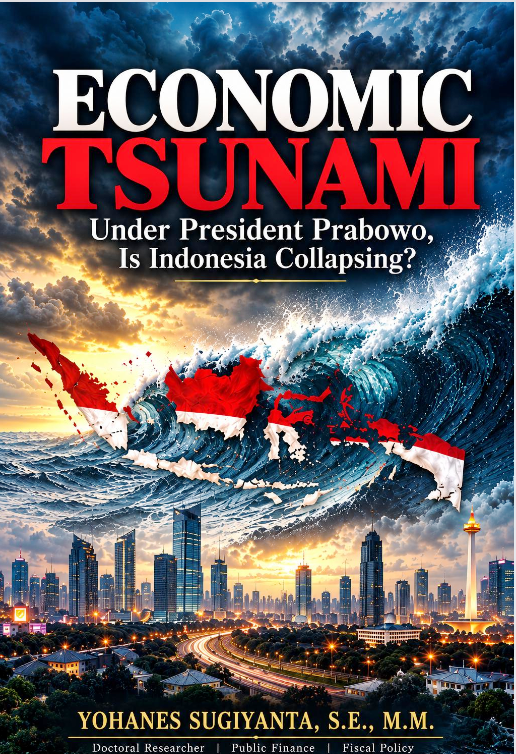
 | | Judul Buku | : | ECONOMIC TSUNAMI Under President Prabowo, Is Indonesia Collapsing? | | Pengarang | : | Yohanes Sugiyanta, S.E., M.M. | | ISBN | : | | | Tahun Terbit | : | 2026 | | Jumlah Halaman | : | 485 | | Harga | : | Rp. 50.000 | | Stok | : | 180 | | | Download |
Deskripsi:
ECONOMIC TSUNAMI
Under President Prabowo, Is Indonesia Collapsing?
Indonesia stands at an important economic crossroads.
Under President Prabowo, the country is pursuing an ambitious development agenda centered on economic growth, industrialization, downstreaming, food and energy security, human capital, investment, and stronger state capacity. At the same time, Indonesia faces persistent challenges involving productivity, fiscal space, household purchasing power, regional inequality, global trade uncertainty, and institutional capacity.
Economic Tsunami examines these challenges through evidence, economic mechanisms, and resilience rather than political rhetoric.
The book begins with a fundamental question: What would economic collapse actually mean for Indonesia? It then develops a framework for distinguishing normal expansion, slowdown, structural stress, systemic crisis, and economic breakdown.
From there, the analysis moves beyond headline GDP figures to examine how economic growth reaches ordinary households through employment, wages, purchasing power, and middle-class security. It explores the productivity foundations of growth, human capital, regional disparities, public finance, debt, taxation, industrial policy, downstreaming, state assets, global trade, the rupiah, financial markets, energy and food security, poverty, inequality, and the vulnerabilities of Indonesia's middle class.
The book also examines the economic architecture of the Prabowo era and asks a broader question: can policy ambition be converted into sustainable productivity, stronger fiscal capacity, better jobs, broader prosperity, and greater economic resilience?
Rather than offering a predetermined verdict, Economic Tsunami invites readers to test the evidence for themselves.
Its central message is clear: economic resilience is not the absence of vulnerability, and economic pressure is not necessarily economic collapse. Indonesia may face serious structural challenges while retaining significant economic buffers and opportunities for reform.
Ultimately, the book asks readers to look beneath the headline numbers and examine what truly matters: productivity, real incomes, fiscal capacity, investment quality, household resilience, regional opportunity, institutional performance, and the ability of Indonesia's economy to absorb shocks and transform them into long-term strength.
Sinopsis:
Economic Tsunami: Under President Prabowo, Is Indonesia Collapsing? is an analytical work of economic and public-policy nonfiction that examines Indonesia's economic trajectory during a period of political and economic transition.
The book does not assume that Indonesia is collapsing. Instead, it treats the word “collapse” as a proposition that must be tested against evidence. Its analytical framework is built around three principles: evidence, mechanism, and resilience.
The journey begins by establishing Indonesia's economic starting point at the beginning of the Prabowo administration. The country entered the period with positive economic growth, a functioning financial system, significant foreign-exchange reserves, a large domestic market, and substantial productive potential. At the same time, it carried structural vulnerabilities involving productivity, fiscal capacity, job quality, regional concentration, and household economic security.
The book then asks what economic collapse would actually look like. It distinguishes between a slowdown, structural stress, systemic crisis, and economic breakdown, emphasizing that no single indicator—whether GDP, inflation, the exchange rate, debt, or the stock market—can determine the condition of an entire economy.
The analysis proceeds through the major components of Indonesia's economic system: growth and productivity; purchasing power, employment, and the middle class; human capital and regional disparities; the state budget, debt, deficits, and tax reform; industrial policy and downstreaming; state assets and investment; global trade and financial conditions; the rupiah; energy and food security; poverty and inequality; and the ability of households, firms, and institutions to withstand economic shocks.
A central theme is the difference between economic stability and economic transformation. Indonesia can maintain growth while still facing weaknesses in productivity and job quality. Likewise, economic resilience can coexist with structural vulnerability. The book therefore moves beyond the question of whether GDP is growing and asks whether growth is sufficiently productive, inclusive, sustainable, and capable of improving living standards.
The later chapters develop a reform and resilience framework. The book argues that sustainable transformation depends on the interaction of fiscal capacity, productivity, private investment, human capital, trade, institutional quality, household resilience, and effective implementation.
The final question returns to the title: Is Indonesia collapsing?
The evidence examined in the book does not justify treating “collapse” as a simple description of Indonesia's economic condition. Instead, the country is presented as an economy facing real vulnerabilities and structural challenges while also possessing significant buffers, productive potential, institutional capacity, and opportunities for reform.
Economic Tsunami ultimately shifts the discussion from fear to analysis—from predicting collapse to understanding resilience, from political rhetoric to measurable outcomes, and from short-term economic pressure to the long-term question of whether Indonesia can transform its economic structure and build a more productive, inclusive, and shock-resistant economy.
|
|